

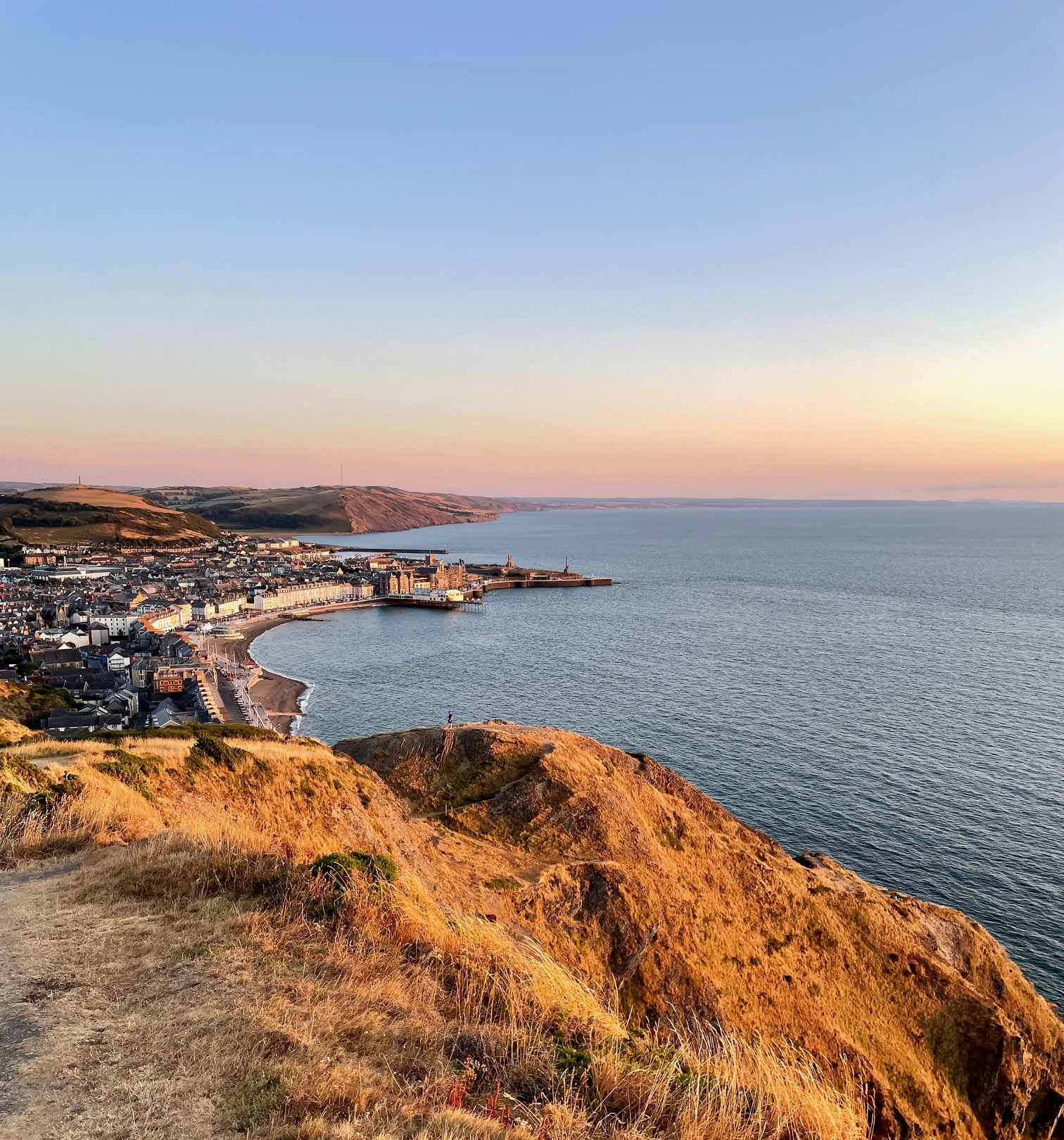
I recently spent two weeks in Aberystwyth for intensive Welsh-language classes. Here’s a little diary of my time, mostly notes I wrote to myself as it happened to capture a bit of the experience.
Arrival
We arrive in Aberystwyth by bus—a familiar route for me. I live in Abertawe (Swansea) but I’m a PhD student at Bangor University. I take the train to Caerfyrddin (Carmarthen) and then the TrawsCymru bus north to Bangor about twice a month.
It’s the night before classes start. I’m riding the high of half-conversations in Cymraeg on a recent road trip with a friend from America. We stayed overnight in Blaenau Ffestiniog. In the morning, I gave my order at the cafe in Wenglish (Welsh-English). When we stopped at the wool mill in Trefriw, I spoke at length in faltering (but excited) Welsh to one of the women running the shop. She offered me all sorts of doo-dads—magazines in Welsh, the Eryri park guide, and a sample of blue and white wool crafted in traditional patterns. When I’m doubting my ability, I remember the delight blazing in her eyes at meeting an American learning Cymraeg.
Day / Diwrnod 1
My husband isn’t doing the Welsh course, but he’s staying with me. (He wants to learn Cymraeg, and he’s picking up bits and pieces, but he is from Argentina and he wants to find someone who can teach him through Spanish instead of English.) We’re in a pleasant self-service B&B near the beach—and that means a stiff hike up the hill to the university first thing in the morning. I quickly shed my jumper as my blood gets pumping. I’m out of breath and dabbing my forehead with a Kleenex as I join a bashful group of a half dozen learners gathered outside for registration. No need to ask if I’m in the right place. I can’t imagine another group of socially awkward folks (like me) on campus this early in the morning in mid July.
I join a sylfaen (foundation) course led by a woman named Brid. She’s fantastic. Her humour gives me Sister Michael vibes (Derry Girls). And we have a great cast of characters in our class. Among others, there’s a woman born in Australia to Welsh immigrants, a semi-retired man from Manchester who started learning because of an ex who spoke Welsh, and a lad from the valleys with loads of tattoos who’s an Episcopalian priest-in-training.
Day / Diwrnod 2
Brid offers an aside about using the correct adjectives for people who use they/them pronouns in Welsh (nhw). I’m grateful for the inclusive course material. It reinforces course coordinator Felicity Roberts’s welcome yesterday: this is a space where everyone is welcome, and should see their experiences reflected in the material. My fellow students are receptive and interested. I wish there was a bit more, but it’s a good starting point.
Day / Diwrnod 3
I feel like things are going at a slower pace than what I hoped—and yet every time the tutor speaks to me, my mind goes blank and I’m not sure what she’s saying. I’m also reminded that learning language isn’t just about ticking a list of your capacity to switch between verbal tenses with ease. Fundamentally, it’s about communication and community, and I relish the chance to be in this room building new connections through a new language.
Day / Diwrnod 4
I’m picking up more of the Welsh that’s used in class now. Things don’t feel too slow or too fast. One of the things I like is that the instructor isn’t just teaching from the book. She changes things up with all sorts of activities. Earlier this week, she even had us memorising a dialogue in the book. She’s clever, and she has us half-way into memorising it before we know what was happening. I wouldn’t have thought I could memorise that much in Welsh, but somehow we’ve all managed.
In the evening, I go to Noson y Dysgwyr (Learners’ Night) at Eglwys y Santes Fair in town. I’m not a religious person, but it feels special—spiritual even—getting to sing the old Welsh hymns together. I think of my Dad, and I get a tear in my eye thinking of his quiet love for the Welsh hymns he doesn’t understand. In some small way, I feel like I’m here for him.
Day / Diwrnod 5
I’m on my way home after the first week of class, and I’m equally delighted and exhausted. I have enjoyed my whole experience and I’m excited for Monday morning. I hope that a couple days away will help the new pathways in my brain start to form more deeply.
My instructor has been terrific. She’s got great energy and understands that learners need to feel comfortable and supported—and that a few chuckles along the way never hurts. (Dim straen cyn 10 o’r gloch! No stress before 10 o’clock!)
I have really enjoyed the new connections this week. That’s what language is about after all! I hope that I might be able to stay in touch with my classmates after the course is over, but I don’t want to be the overeager American peddling my social media handles.
Day / Diwrnod 6
Back for the second week. Instead of feeling rejuvenated, I feel exhausted. But I’m trusting the process and grateful for another week with my instructor and classmates.
I had a small triumph over the weekend, writing almost an entire e-mail to a friend in Welsh. This is something that used to petrify me. I would leave e-mails unanswered for weeks at a time because I felt shame over my inability to respond in fluent, polished Cymraeg.
Even though we’re only halfway through the course, I’m already thinking ahead to what comes after this. I’m eager to keep learning. I want to get more involved with the Welsh-language community in Abertawe, which I’ve sheepishly avoided—partially out of busyness, and partially out of that stubborn feeling of shame and inadequacy that is the enemy of language learning.
Day / Diwrnod 7
After class, a few of us go to watch Y Sŵn, a film about Gwynfor Evans’s campaign to launch a Welsh-medium television channel in the 1980s. The film is good, if occasionally clunky (including Gandhi and Martin Luther King, Jr. popping up to offer advice to Evans). Afterwards, I run into Rhys Davis, the Ohio-born Cymro I met at NAASWCH in Rio Grande last year. We chat only briefly (his Welsh is much better than mine, so I apologise—mae’n ddrwg gen i), but this chance encounter reminds me about the incredible breadth and strength of our global community.
Day / Diwrnod 8
The two weeks are quickly wrapping up. There are still the pethau bychain I hoped to do: climb Constitution Hill (Craig-glais), go for a dip after class, connect with friends in other courses. Instead, I take a nap.
Day / Diwrnod 9
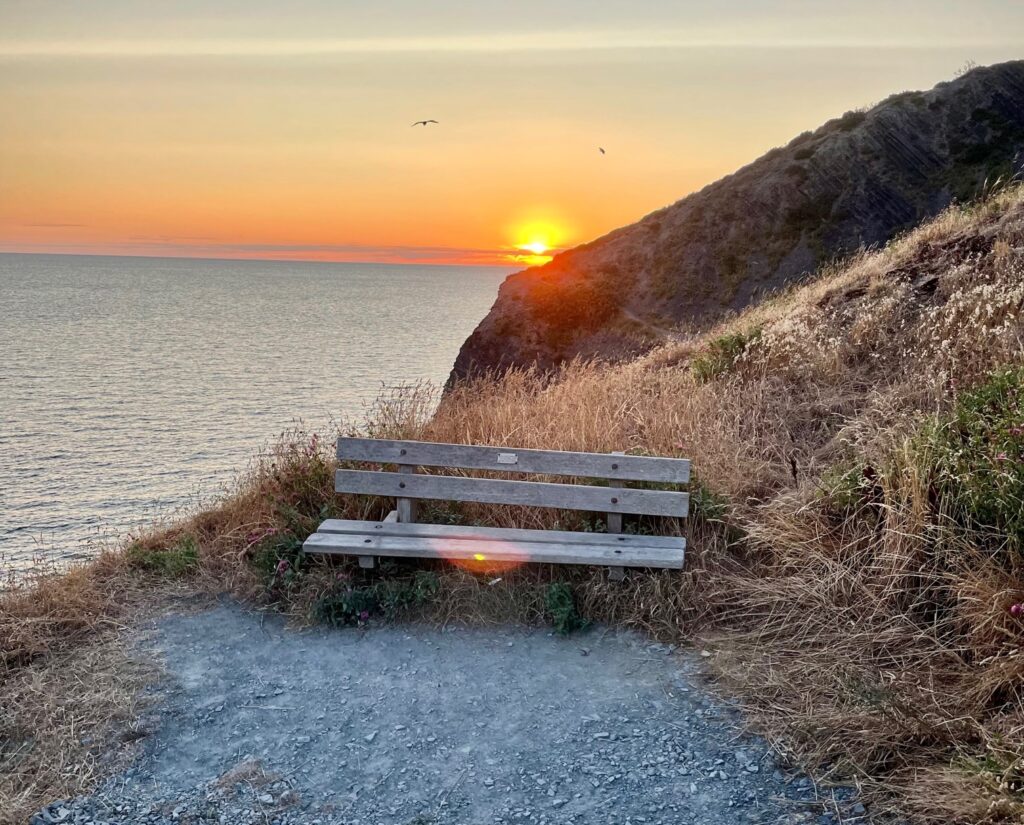
My social battery is completely depleted tonight. Despite my best intentions, I don’t make it back up the hill for the short film about Hedd Wyn, the legendary poet, at the National Library (Llyfrgell Genedlaethol). I again opt for a nap. Still, I’m determined to get back to y pethau bychain, and I climb Craig-glais in time for the sunset. I think back to my Dad and I visiting on Easter Sunday in 2011, and our polite astonishment when a couple from Pembrokeshire told us about the bridge that used to connect Cymru and Ireland. Now I know the legend of the giant Bendigeidfran, and I imagine him wading off to an ill-fated battle beyond the sunset.
Day/ Diwrnod 10
We sing “Hen Wlad fy Nhadau” on the steps outside the art centre after a group photo of the students and tutors. As we walk back for the final hour of class, a friend confesses that he didn’t know the words very well, citing his antipathy for nationalism. I’m sympathetic, but point out there’s something far different about “nationalism” (or perhaps a better word is “patriotism”) in a country of three million compared with the superpowers jockeying for control over the wider world.
The final hour flies by. I’m somewhat relieved that I need to rush off for my bus—perhaps the most Midwestern thing about me is that I’m terrible at goodbyes. Brid shakes my hand and wishes me well. I hope to cross paths with the people in my class again, but I will miss this space that we’ve created together over the past two weeks. I’ve grumbled at climbing up the hill each day, and craved afternoon naps in my exhaustion—but I treasure the friendships I’ve made, and the Cymraeg I’ve accumulated.
Heading Home
I’m on the bus for Caerfyrddin, and one thought sticks in my mind. While care is taken at the beginning of the course to state the organisers’ commitment to an inclusive environment and a zero-tolerance policy toward any discriminatory behaviour, those in attendance are overwhelmingly white. When I’m in this sort of space, I am always asking myself whether or not my husband, of mixed European and Indigenous ancestry, would feel welcome. I feel confident he wouldn’t have faced anything worse than curiosity about his background, but as many minorities can attest (women and LGBTQ people included), it can be utterly exhausting to be the only one in a space for an extended period of time.
I commend the organisers for an excellent week and their commitment toward inclusion. This issue isn’t one for the organisers alone to address. This represents a broader challenge for us in Cymru—one that we must all commit to, especially in a broader political context in which immigrants and racial minorities are under constant pressure.
Last week, I was listening to “Ffyrd y Wlad” (“Country Roads” in Welsh) on my way back to Abertawe. But tonight, my ears crave a different sound, my feet a different rhythm. So I play Julieta Venegas—a Mexican singer born in California who sings in Spanish. It’s not a competition. Each language is a part of me: the English I was born with, the Spanish of my husband and his family in Argentina, the Welsh of my family’s ancestral home—the place I’ve come back to, where I hope to start my own family someday soon.
I change for the train in Caerfyrddin. Afon Towy (River Towy) spreads its arms out wide to embrace the shallows of the bay. The tide is in. Herons wade along the shore, hunting for their meal. The sun is sinking behind Castell Llansteffan. Dylan Thomas’s boathouse is back there somewhere around the bend.
I haven’t been trying to ask or answer the question, but here it is: Why learn Welsh? In brief, because it transports the wonders of this magical land into your very soul. Wherever I go, I will carry this land with me.
My head is full—and so is my heart.
If you enjoy my writing, please consider supporting me on Patreon for as little as $2/month!