

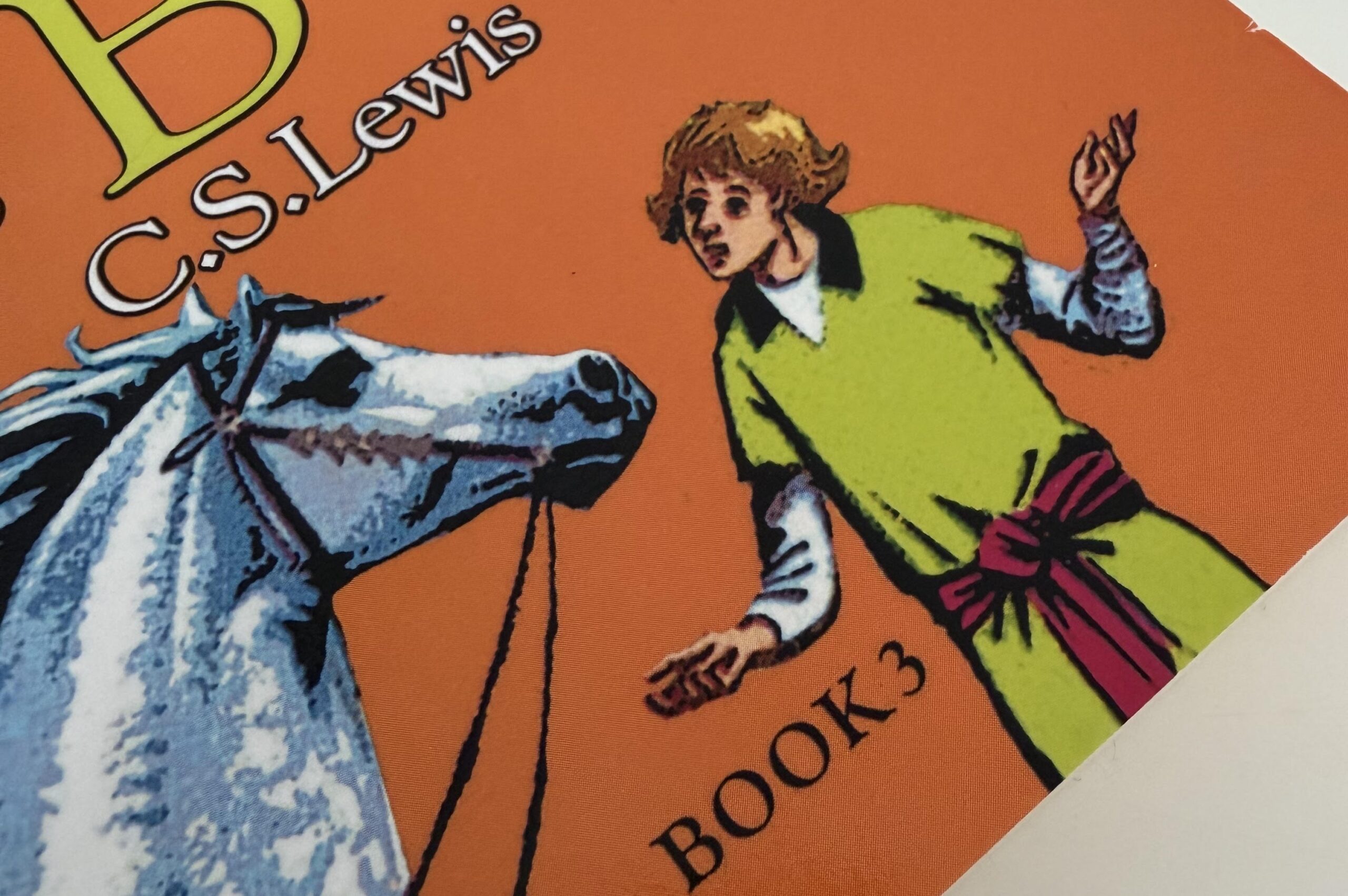
Since my husband picked up a box set at a charity shop this summer, I’ve been re-reading The Chronicles of Narnia. I loved The Magician’s Nephew: the non-stop action, the clever backstory, the earnestness of Polly and Digory, the zany (and utterly creepy) uncle, and the unhinged Jadis brought to life from some post-apocalyptic sleep.
Alas, The Horse and His Boy was no such treat.
Lewis introduces us to Shasta, a poor boy living in Calormen. We immediately get the sense that there is something peculiar about Shasta’s predicament. He is out of place. Destined for something different. Having washed up on shore after a shipwreck, a cruel fisherman adopts him. In a land suffocated with Orientalist tropes, Shasta is a sort of (English) rose among thorns.
I’m not trying to play PC police here. When we look back on literature from past eras, we do so at risk of finding plenty to upset our contemporary sensibilities. There is, for example, an Orientalist undercurrent in The Lord of the Rings, reflected in the peripheral presence of the “wicked men” of the south riding their fantastic oliphaunts into battle. It’s there, and the attentive reader can’t help but notice it. But it’s a far cry from the firehose of Orientalist tropes at full blast in The Horse and His Boy. As much as it’s offensive, it’s boring.
The magic of The Lion, The Witch, and the Wardrobe and The Magician’s Nephew is that of the Otherworld, brought forward from Medieval Celtic lore and into the banality of modern Britain: the magic rings that teleport ordinary children to witness the formation of a new world. The wartime refugees who slip through the back of the wardrobe to become kings and queens of Narnia.
The Horse and His Boy is utterly devoid of this magic. From the time of Shasta’s encounter with Corin, the prince of Archenland, the book’s great “riddle” is solved — less than halfway through the story.
Wait, you might say, but it’s a children’s book.
Indeed.
But children’s books are most effective when they understand the reader to be a capable co-conspirator rather than clueless. Worse yet, Shasta’s ascension smacks of racialised pre-destiny. Living amongst the Calormene (a deeply uncomfortable name in itself, seeming to evoke the Spanish calor for heat while sitting unfortunately close to “coloured”), Shasta is positioned as superior precisely because he possesses the decent and noble character that the author ascribes to the apparent white races of the north.
With nothing left to unravel in the “mystery” of Shasta’s character, we turn to the chase between the warriors of Calormen and our band of heroes racing across the desert. Accompanying Shasta, we have Aravis, who is moderately more interesting than Shasta, and the two talking horses, Hwin and Bree. One of the more interesting moments occurs when Aslan explains to Aravis why he gave her a mild wound on their flight to Archenland. Aslan is the first to speak in the below dialogue.
“Do you know why I tore you?”
“No, sir.”
“The scratches on your back, tear for tear, throb for throb, blood for blood, were equal to the stripes laid on the back of your stepmother’s slave because of the drugged sleep you cast upon her. You needed to know what it felt like.”
“Yes, sir. Please—“
“Ask on, my dear,” said Aslan.
“Will any more harm come to her by what I did?”
“Child,” said the Lion, “I am telling you your own story, not hers. No one is told any story but their own.”
As a writer skilled at balancing complexities and tensions (e.g., Aslan’s wildness and goodness), we expect this sort of writing from Lewis — and his unique talent of doing so in a way that’s accessible for audiences of all ages. Unfortunately, this is the exception in The Boy and His Horse.
The characters who accompany Shasta throughout the story are unimaginative and shallow. Arsheesh, Shasta’s adopted father, is nothing more than a racist trope. Aravis is somewhat more complex, but she shows little nuance besides her wish to avoid marrying a much older man (a plot point that further emphasises Western stereotypes and prejudice). Worst of all, I would argue, is the Hermit of the Southern March, whose presence in the story is nothing more than a plot device to provide shelter to the four travelers, and then — in a truly low point for Lewis’ writing — recount the final battle through a magic pool of water.
By this point, the book is nearly over, and I couldn’t wait to put it down.
Of course, we still have to officially discover that Shasta is indeed Cor, the long lost son of the king of Archenland — and, being minutes older than his twin brother, the heir to the throne (all taken in good stride by his pleasure-seeking sibling!). Pre-destiny and all that. Yawn.
The Horse and His Boy is unimaginative and predictable and diminishes the magic of Narnia. And with the Pevensie children in the background, it’s a missed opportunity at nearly every turn to explore the sorts of questions that readers craved to ask. We get a fleeting glimpse here of Susan’s courtship, but it’s attenuated by the racist caricature of Rabadash.
Lewis is a master of amiable familiarity and keen observation without condescension. At his best, he lets the reader know that adults don’t quite have it all together — indeed, that even those who appear very wise were once themselves scared little boys, fumbling their way through their first adventure. There are moments when Lewis’ voice breaks through, but it’s little more than a passing beam of light in a dull and predictable story.
2 responses to “The Horse and His Boy: Or, When the Classics Let Us Down”
I read through this book with my oldest, and while he liked the action and the taking animals, the descriptions of the dwarves’ meal, he didn’t really like the story as a whole.
Funnily enough, he REALLY enjoyed the battle-as-describes by the hermit….but that’s probably because we were in the midst of the World Cup, and I read it like a British football commentary.
Well, then. I’ll have to go back and give that a try. 🙂
I agree with the talking animals and the dwarves’ breakfast!
Looking forward to getting stuck into Prince Caspian.