

After my husband and I met, family and friends asked the natural question on such an occasion: when can we meet him?
My husband, however, is Argentinian. Being American, my friends imagined it was a simple question of finding the right date to book a flight. They had no idea it meant applying for a visa and a long waiting period due to the post-COVID, Trump 1.0 backlog.
So we got married in Buenos Aires in 2023. It was a beautiful ceremony. A judge officiated in a San Telmo courthouse. She beamed as she asked about how we met, peppering the proceedings with me encanta as we told her how we fell in love, how we knew this was meant to be. Afterwards, we celebrated in a neighbourhood parilla. In her high heel shoes, my husband’s godmother walked back down the cobblestone street to retrieve the homemade cake she made, and the staff pulled out extra plates and cutlery.
My Spanish wasn’t very good at that point, so I needed an interpreter to participate in my own wedding ceremony. But it was a day full of love—and that’s a language that needs no translation.
We planned to have a later ceremony in the United States for my family and friends.
Today, I doubt that will ever happen.
Daily Life and Love and Marriage
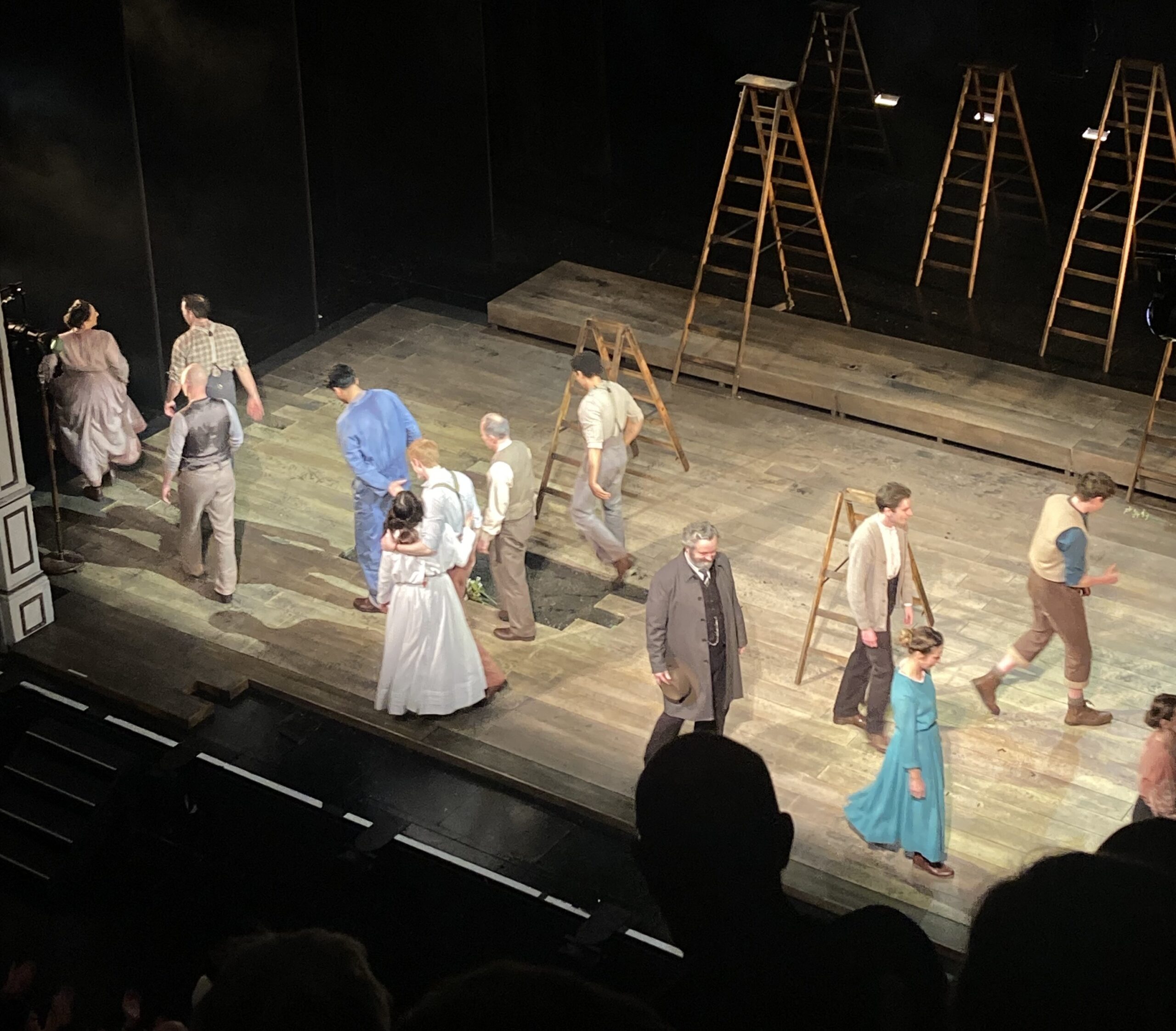
This past Friday, we went to see Michael Sheen’s production of Our Town at the Swansea Grand Theatre. I didn’t know the play, but after crying heavy tears at Nye, I should have been better prepared.
It was a bit surreal watching a play on life in America through a Welsh lens: a little window into a state I’ve never been to, a time I didn’t live in—and a land that’s increasingly hostile by the day. Divided into three acts (Daily Life, Love and Marriage, and Death and Eternity) the first two are joyous and buoyant, but they carry on. I started squirming in my seat, eager for a chance to stretch my legs and grab a pint.
Sitting back down, I glanced at the clock. The play was supposed to end at 10 and it was already 9:15. Almost over. How could that be?
Death and Eternity have a way of sneaking up on you. Before we knew it, it was over. We were back out on the street, huddled against the cold as we walked the rainy blocks home.
When we got in, my husband asked how I was. No sooner did I say “I’m good,” than I broke into sobs.
Buenos Aires to Bangor
After we got married in August 2023, we left for Cymru. I started a master’s programme at Bangor University and we settled into our new life—what we imagined would be an intermission between Argentina and America as we applied for my husband’s residency in the United States. I hired a lawyer to help us navigate the paperwork, and we submitted our application.
Our year in Bangor slipped through our fingers. My husband volunteered at the Pontio cinema. I wrote my dissertation. We explored a bit, and even traveled together to Radnorshire to visit the church where my ancestors had been baptised and the farm where they used to work.
All in all, an amazing year. Everything I hoped it would be. And, as we started to think about what came next, the American people went to the polls.
Death and Eternity
I’ve lived enough now to think about Death and Eternity.
These days, I think about my husband’s brother-in-law. He had a difficult childhood with few opportunities in life, but he loved his family fiercely and did everything he could to provide for them. A terrible workplace accident sent him to the hospital this fall. After a month of recovery, we thought things would be OK. But Death passed in the night and took him.
In our final goodbyes at the mausoleum, my mother-in-law turned to the mourners and invited us to offer him un aplauso. It still chokes me up thinking about it.
Then there’s the children he left behind. His youngest graduated from primary school in December, and his oldest just turned sixteen.
I think of his wife. Like me, she’s a runner. Like me, I think she’s chasing a glimpse of Eternity when she’s out there with nothing between her and the Earth besides a few millimeters of rubber and a pair of socks.
My Spanish is stronger now—sufficient, anyways, that I can understand my husband’s calls with his mom as he tells her about our life abroad. I don’t want to be nosy, but I listen in. Just a little. I believe there’s something sacred—and radically optimistic—in this exchange, as he describes a world she’ll never know for herself.
When I listen to his words, I hear life’s buzzing, I feel Eternity echoing. I imagine myself holding the letters my ancestors wrote home after landing in Canada and moving to Michigan. I feel the stubborn and resilient persistence of the migrant, far from home, who can only bring themselves to share the good and the great and the magical from their life far away, determined to not disappoint their family—determined to spare them the obstacles we overcome each day.
I hope to be on the other side of this one day: to listen as my children tell me the wonderful things they have seen and lived that I will never know.
Back to Argentina
A week after Trump took office, our lawyer sent us an e-mail. Good news. You’ve been approved to go to the next round of your immigration case. We talked timelines, legal and processing fees, and the documents we needed to submit.
I had no doubt in my mind that this was still the right thing to do. Our plan was to take things slow. To take our time. Let the chaos play out, let the national temperature simmer back down.
That changed when we started to hear stories about people being detained at the border for weeks at a time for the smallest infractions. For me, that was it. I couldn’t ask my husband not to travel, not to go home, not to visit his family for five years.
Five years, too, is Eternity.
What if … we don’t go to the US?
I can picture where we were when the words fell out of my mouth, but I can’t remember the words I used. It was spring in Buenos Aires, but it already felt like summer. I thought maybe I was being dramatic and I didn’t know what my husband would think. Immediately, though, I could see his relief.
I’m so glad you said that. I didn’t want to say anything because I didn’t want to disappoint you—but I don’t want to do this.
Our Town
On a sunny November day, we drove over to Radnorshire. The mountains were dusted with snow. On the way up, we had to wait for a herd of cows to pass by. It was undiluted magic.
We met a friend in Presteigne for coffee, and to return a box of materials on the Merediths of Radnorshire that he had lent us. As the sun set, we hiked a short section of Offa’s Dyke. It was one of those moments in life where you pinch yourself because you can’t believe where you are, what you’re doing—how happy you are. In stumbling words, I told my husband thank you. Thank you for saving me. I had been married before. I had been deeply unhappy and hadn’t believed I deserved any better until I met him.
As a bi-national couple, our story has never been a simple one—but it’s always been good.
In the closing moments of Our Town, one of the characters remarks: “It goes so fast. We don’t have time to look at one another.”
I get to see my parents about twice a year. When we say goodbye, my dad’s voice catches. What is it that’s left unsaid in those moments? (If anything.) Is there anything that could be said that I don’t already know from that small hiccup? That small hitch in his breathing is, I think, worth ten thousand words.
I saved my tears for Our Town until I got home. The same way I saved my tears from our most recent goodbye until the train doors closed. It surprised me how fast we started to move. My parents were still on the platform, searching the tinted window for a sight of us. Before I could go bang on the window, we were already gone.
It’s been a year now. Just this past week, our US lawyers sent a follow-up asking if we wanted to move forward with our immigration case.
Normally, if I had to give an answer about something that involved my husband, I would ask him first—even if I were confident of the answer.
Not this time. I responded immediately and without hesitation: thanks, but dim diolch.
If you enjoy my writing, please consider supporting me on Patreon for as little as $2/month!