

I stumbled across this on my most recent visit home, as I searched through old notebooks and papers from years past.
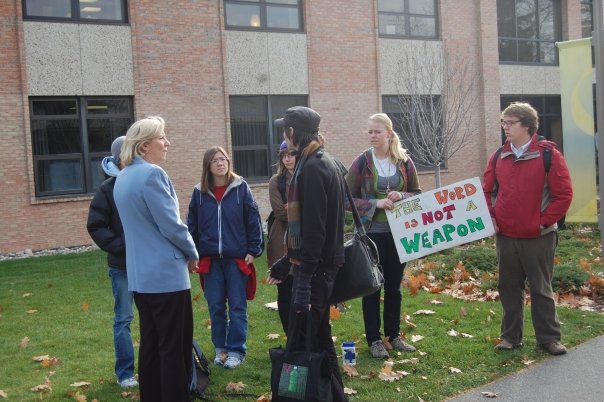
In 2009, I was invited to speak on a panel of queer students at Calvin University. The annual event, known simply as “Panel” amongst LGBTQ students on campus, was almost a rite of passage for us: a way to show that you’d dutifully wrestled with your identity, and had come out the other side jaded, but not hopeless; bitter, but with a bit of humor intact.
These are the remarks I offered.
—
When approached to speak tonight, I didn’t initially take to the idea of writing what I wanted to say in advance. However, I recognize my twofold limitations: First, I must work with a time constraint, and secondly, I am a writer—not a public speaker.
It is very difficult to know just what to say on such an occasion. I feel simultaneously compelled to spill out the guts of my life story from the age of 5 and, on the other hand, shrug my shoulders and say, “Why don’t you tell me about being straight?”
I’ve spent way too much time deliberating about where I would start out tonight, finally settling on my senior year of high school when I first admitted to myself that I was gay.
My senior year of high school was great. Maybe it was a lot like yours: a mixture of accomplishment, challenge, fun, and awkward all at the same time. I attended NorthPointe Christian—a warm, yet staunchly conservative community where I was nourished by the care and affection of friends and teachers. I have a lot of great memories and respect for the people there who helped make me who I am today.
At the same time, I will not hide my resentment and the damage that stemmed from those years. When bashing gays was OK with Jesus and pronouncing that all gays should be killed went unchecked by members of the faculty. Which is not to say that everyone I knew was a homophobe. The institution simply chose to overlook this when and where it occurred as a part of normal operating procedures. In fact, homophobia was encouraged.
Unwittingly, my senior Bible ethics class provided my life a turning point. A unit on homosexuality pushed me out of an indefinite period of questioning to begin my journey to self-acceptance.
In sum, the unit was a week of propaganda where my classmates didn’t discuss whether or not homosexuality was a sin, but instead whether it was uniquely worse than others.
Needless to say, this wasn’t a great self-esteem boost. I tried not to explode each day for a week as a film we watched essentially propagated that being gay equates with loose sex, AIDS, and predatory relationships. I still resent this today and continue to live with an image in the back of my head of what I’m supposed to be—what my high school told me I was.
Unlooked for good came of it, though. Some friends of mine openly criticized the film supplying me with the first inkling that I might find acceptance if I started coming out. And, after painstaking deliberation, I did in fact come out to my best friend. Looking back, it’s incredibly easy for me to forget how terrified I was to tell one person who knew me and cared about me. I remember stalling, second-guessing myself, shaking all over, and feeling really stupid—like no normal person would ever be caught dead doing such a ridiculous thing, coming out to someone. My friend affirmed me throughout our conversation and assured me that this was normal and I was no worse of a person for it.
I didn’t come out to my family until the end of my freshman year at Calvin. While none of my immediate family members ever propagated misinformed homophobia, we made as if it simply didn’t exist in our little suburban, white, conservative world. I had no programming to fall back on to predict how my family would react. My mom and I shared a tearful dinner at Applebees where our waitress had to supply a steady stream of napkins to wipe our eyes as the meal dragged on. It hurts a lot to think of this time because I still feel that in some way, I’ve let my family down—even if they don’t say it.
In the end, though, they’ve been loving and accepting. My mom told me she had been wondering since the age of four whether or not I was gay. It was harder for my dad, though he agreed that part of him had known without being told, too. Though we disagree about a plethora of subjects daily, my family continues to support me.
My sophomore year was difficult. I suddenly had the support I had known on campus taken away from me when I moved home. I definitely had my friends but I also had the startling realization that most of the new friends I’d made since starting at Calvin were gay. Certain friendships just felt hollow. But what can you do when you don’t feel wanted by a majority of people on campus? My life had gone from repressed assimilation to an authenticity perceived as antagonistic.
Also in my sophomore year, I became very agnostic. After my freshman year, I was very cynical about Christians. The atheists I knew were acting more like Jesus than some religious people I knew. And I mean to imply more than simply my own feelings of rejection from certain Christians. I was sick of men trash-talking women. I was disgusted by stories of fellow students being raped by boyfriends, peers, Christians. I heard that a friend had been left by her boyfriend after he got her pregnant so that he could focus on becoming a youth pastor.
Yesterday, I was reading The Good Book by Peter J. Gomes when I came across the following paragraph. Though it discusses religion in the context of racial justice, I feel the application may be broadened.
“One of the greatest paradoxes of race in America is the fact that the religion of the oppressor, Christianity, became the religion of the oppressed and the means of their liberation. Black Muslims are incredulous how any Black person in America could possibly be a Christian, given the legacy of white Christianity. The answer, of course, is that if Christianity in America depended upon white Christians, there would be no right-minded Black Christians. What is the case is that Christianity, and the Bible in particular, did not depend upon Christians for its gospel of inclusion, but upon God. Thus Black American Christians do not regard their Christianity as the hand-me-down religion of their masters, or an unnatural culture imposed upon them and thus a sign of their continuing servitude. No! They understand themselves to be Christians in their own right because the Gospel, the good news out of which the Bible comes, includes them and is in fact meant for them.”
Ultimately, I had to face the simple reality: people will always let me down. I will let others down, too. God is bigger than human failings and so I made up my mind that I would not let the misdeeds of those who claim God’s name deter me from seeking it out myself.
Since coming out, I’ve become acutely aware of injustice in a way that I never could have been otherwise. I grew up with every privilege a person could want: my skin color, my sex, my religion, my socio-economic background. On my better days, I wouldn’t change this for anything. I’m a more compassionate person and a better citizen for it.
I want to live a quiet life. I would rather spend time writing or going on a jog or playing tennis or having a night out with friends. Not fighting red tape at Calvin, not battling for my own square inch, not scanning the school paper for misinformed articles that demonize and belittle. Because of this, I am pursuing transferring schools. Over the past year, I have realized that the life I want is not possible here at Calvin, or in West Michigan.
This conversation we are participating in tonight is a necessary one, and I’m so glad that you are here. This is a part of who I am, and the fact that it can and does define me in some people’s eyes weighs me down. Does it matter? Of course. As much as sex, race, creed, culture, religion or anything else.
The conversation must continue. I applaud Calvin for providing space for this conversation when many other Christian institutions continue turning their back on this type of dialogue. However, progress needs helping. We cannot rely on our peers, fellow Christian institutions, to measure whether or not we are sufficiently welcoming to LGBT people—but rather on members of our LGBT community who must deal with the realities of this climate day after day. For many of you, this is one night of the year. For others, we live this year round. We carry this weight not because we chose to be who we are, but because we choose not to pretend otherwise. We choose honesty. Thank you.
If you enjoy my writing, please consider supporting me on Patreon for as little as $2/month!