

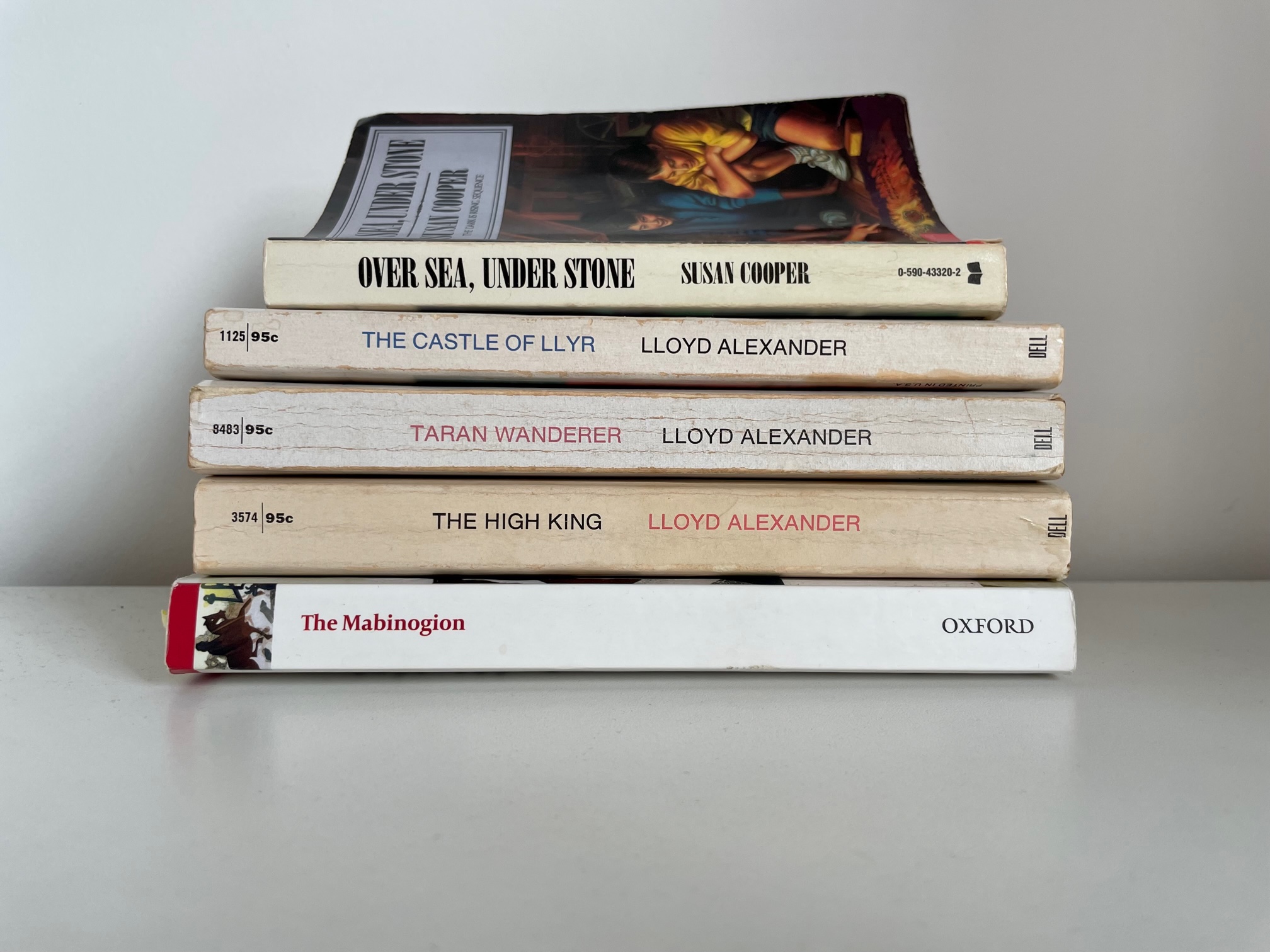
There’s nothing quite as magical as stumbling into a good story. Reliving it? Sometimes that’s another matter.
Over the past couple years, I’ve revisited a few nostalgic favorites from my childhood. It all started in a used book shop in Nova Scotia, where I stumbled across Nancy Bond’s A String in the Harp. Honestly, it let me down a bit. The dialogue felt inauthentic, staged, and horribly adult. I still enjoyed it, but its spark had gone out.
More recently, I returned to another favorite: Lloyd Alexander’s Chronicles of Prydain. Having spent some time with The Four Branches of the Mabinogi in the intervening years, I found myself able to appreciate and understand more of what had inspired his writing. Where Bond’s writing felt much smaller, like a sort of imitation of something it wasn’t, the world of Prydain had grown larger, more vibrant and I enjoyed the writing on an entirely new level.
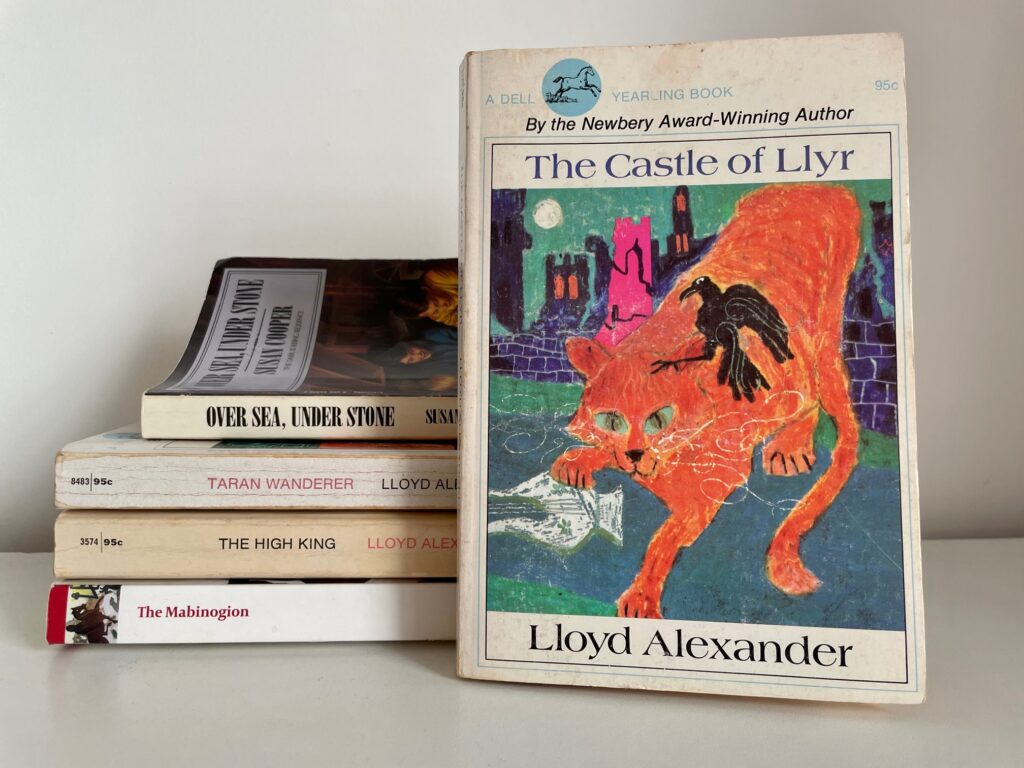
Alexander’s writing is excellent. You can enjoy the book for the story on the page without any outside knowledge of Cymru or Welsh mythology, but with a bit more knowledge than in my teenage years, I felt a deeper appreciation for the references and characters and geography—which isn’t Wales, but whose echoes are certainly Welsh.
For all Alexander’s studied mythology, the characters remain the highlight. Taran, who is brash and clumsy and stubborn, but loving and kind and vulnerable. Eilonwy, with her remarkable wit, snide comments, and determined bravery. Gurgi, who is always out-of-place, but loyal and kind and courageous under a layer of oddity and matted leaves. I think Flam is the one who surprised me the most on the second reading. With his harp strings that snap at the first sign of a tall tale, he’s obviously humorous. But he’s not just comic relief. He’s a voice of reason and level-headedness, the ruler of a small kingdom who relies on judicious decision-making as much as dashing bravery—though his heart longs for life as a bard.
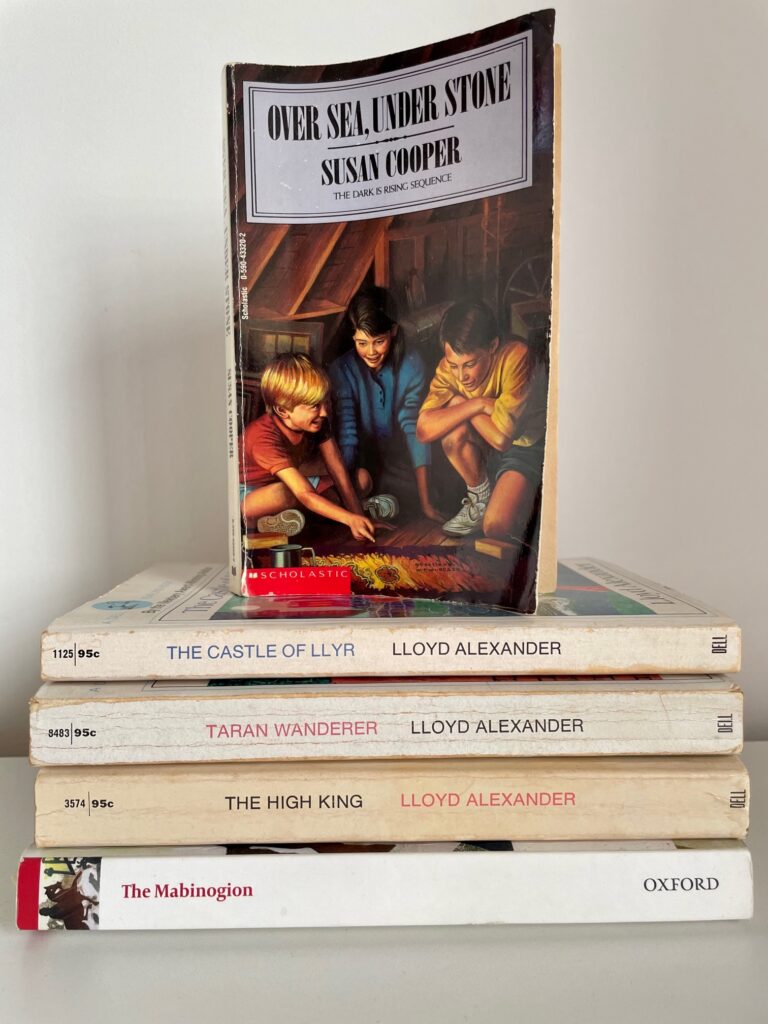
I’m reading The Castle of Llyr now, though I took a little break to read Susan Cooper’s Over Sea, Under Stone. I never got any further than the first book when I read it, so I’m really looking forward to diving deeper into the series and some of her other works.
Cooper’s writing is interesting. It’s verbose—full of excessive adverbs that shouldn’t work, but somehow seem to fit into the background. Querulously. Sepulchrally. In an age where common wisdom urges that we lower barriers for readers, it’s refreshing to experience this kind of writing that takes pleasure in the challenge it offers.
Alexander is more on the Hemingway end of the spectrum when it comes to his economy of words. Sparse, lively, action-focused, with little room for reflection. As much as Cooper is far to the other end of the spectrum, she’s nonetheless judicious. I could cross out a word here and there, but she really doesn’t throw many words away. She’s verbose, but she’s disciplined, detailed—and believable, in a way that perhaps Bond is lacking.
In dialogue between the three children—Barney, Jane, and Simon—Cooper frequently neglects to attribute statements to the speaker, which made me stumble a bit before I realized that she does this selectively. In parts where it really matters who says what, the attribution is present. When the conversation is lively, she allows the speakers’ words to carry you, even as you scramble to piece together whether it sounds like Barney, Jane, or Simon. Once I let go of my need to know, I found that I quite liked it. In a way, it feels more authentic—like the way you might recall key bits of who said what, but with fuzzy in-betweens. It lends itself to the delightfully conspiratorial tone of the book.
While Cooper’s vision is much more believable when compared with Nancy Bond, I take some issue with her integration of mythological elements. Where Alexander is clever and delicate, Cooper’s touch is occasionally heavy, such as the not-so-subtle wink in naming villains Norman and Hastings. In other places, it’s a bit odd, as when their Great Uncle Merry welcomes the children to “the real Cornwall,” but follows that up by naming it “Logres,” an old name associated with Arthurian legend, but associated with England, rather than Cornwall.
When it comes to authors like Alexander or, indeed, C.S. Lewis, there is an enviable level of mastery that allows subtlety—something I myself crave for my own writing, and a doubt-inducing aspiration that’s kept me from putting pen to paper many times over. Lewis’ Narnia nods to the Celtic Otherworld effortlessly, as Alexander uses Welsh mythology as a color wheel to bring his own story to life.
Still, we don’t read children’s books for any sort of accurate depiction of ancient mythology. We read them to voyage to the edges of imagination, to find out who we are—and, perhaps, who we’d like to be.
If you enjoy my writing, please consider supporting me on Patreon for as little as $2/month!